
Your business collects data. Customer names, email addresses, payment details, health records, browsing behavior. Every piece of that data is governed by rules, and those rules carry real consequences when broken.
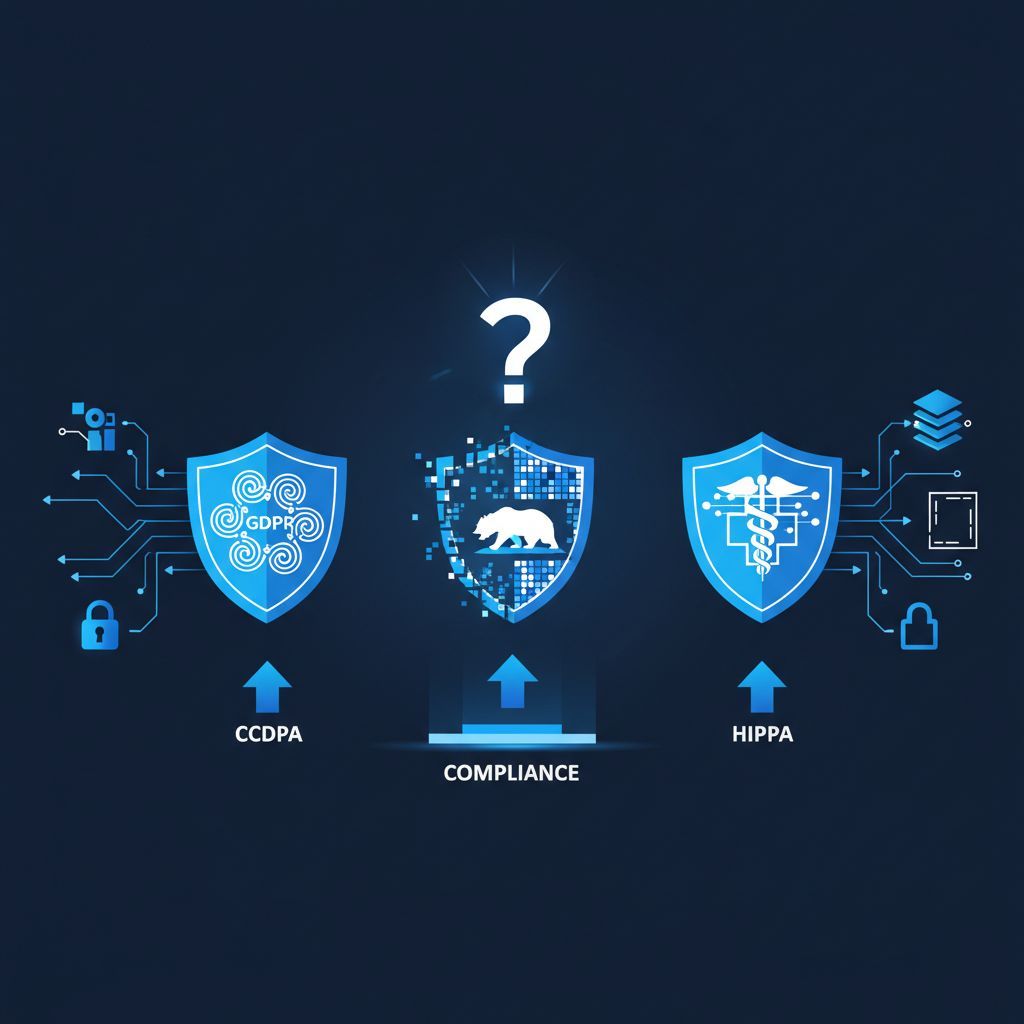
Data privacy compliance is not a single standard. It is a landscape of overlapping laws, each with its own scope, requirements, and penalties. The three most likely to affect your business are GDPR, CCPA, and HIPAA. Knowing the difference between them is not optional, it is the starting point for building a defensible compliance posture.
This guide breaks down all three frameworks side by side so you can identify which apply to your business, what each requires, and how to approach them without wasting time or money on the wrong priorities.
What Is Data Privacy Compliance and Why Does It Matter?
Data privacy compliance means operating your business in a way that meets the legal requirements for how you collect, store, use, and share personal information. These laws exist because consumers and patients have a right to know what you are doing with their data, and regulators have the authority to enforce that right.
The stakes are not abstract. GDPR fines can reach 20 million euros or 4% of global annual revenue, whichever is higher. CCPA penalties run up to $7,500 per intentional violation. HIPAA violations can cost between $100 and $50,000 per incident, with annual caps reaching $1.9 million per violation category.
Beyond fines, a compliance failure can trigger audits, lawsuits, and the kind of public attention that kills customer trust. For small and mid-sized businesses, that combination can be genuinely existential.
The good news is that these frameworks share common ground. If you build your compliance program correctly, meeting one often moves you closer to meeting the others.
GDPR: The Global Standard Set by Europe
Who It Applies To
GDPR (General Data Protection Regulation) was created by the European Union, but it applies to any business anywhere in the world that collects or processes data from EU residents. If a customer in Germany visits your website and fills out a contact form, GDPR applies to you, regardless of where your business is located.
What It Requires
GDPR is broad and principle-based. The core requirements include:
- Lawful basis for data collection: You must have a legitimate reason to collect data, such as consent, contract performance, or legal obligation.
- Right to access and erasure: Individuals can request to see what data you hold on them and ask you to delete it.
- Data minimization: Collect only what you actually need for a defined purpose.
- Breach notification: You have 72 hours to notify regulators if a breach occurs.
- Data Protection Officer (DPO): Required for organizations that process data at scale or handle sensitive categories.
- Privacy by design: Data protection must be built into your systems from the start, not added later.
Best Fit For
GDPR matters most for businesses with any European customer base, international e-commerce operations, or SaaS platforms with global users. If your website uses cookies, analytics tools, or marketing pixels and you have visitors from Europe, you are already in scope.
CCPA: California’s Privacy Law with National Reach
Who It Applies To
The California Consumer Privacy Act applies to for-profit businesses that do business in California and meet at least one of the following thresholds:
- Annual gross revenue over $25 million
- Buy, sell, or share the personal information of 100,000 or more consumers or households per year
- Derive 50% or more of annual revenue from selling consumers’ personal information
Because California is the largest state economy in the US, and because digital commerce makes it easy to do business there without a physical presence, CCPA catches a wide range of businesses, including mid-sized companies that may not realize they qualify.
What It Requires
- Right to know: Consumers can ask what personal information you collect and how it is used.
- Right to delete: Consumers can request deletion of their data.
- Right to opt out of sale: If you sell or share data with third parties, you must offer a clear opt-out mechanism, typically a “Do Not Sell My Personal Information” link.
- Non-discrimination: You cannot penalize customers for exercising their privacy rights.
- Privacy notice at collection: You must disclose what you collect at the point of collection.
The CPRA (California Privacy Rights Act) expanded CCPA in 2023 to add new categories of sensitive data and created a dedicated enforcement agency.
Best Fit For
CCPA is most relevant for businesses in retail, marketing, e-commerce, and any sector that monetizes customer data. It is also a strong signal for where the rest of the US is heading. Virginia, Colorado, Texas, Florida, and over a dozen other states have passed similar laws. Building toward CCPA compliance now positions you for the wave of state-level laws coming into effect over the next few years.
HIPAA: The Standard for Health Information
Who It Applies To
HIPAA (Health Insurance Portability and Accountability Act) applies to covered entities (healthcare providers, health plans, and healthcare clearinghouses) and their business associates (any vendor or partner that handles protected health information on their behalf).
If you are a clinic, dental practice, physical therapist, behavioral health provider, or any organization that touches patient data, HIPAA applies to you. If you provide IT support, billing, or software services to any of those organizations, you are likely a business associate and also subject to HIPAA.
What It Requires
- Privacy Rule: Sets standards for how protected health information (PHI) can be used and disclosed.
- Security Rule: Requires administrative, physical, and technical safeguards to protect electronic PHI (ePHI).
- Breach Notification Rule: You must notify affected individuals, HHS, and sometimes the media within 60 days of a breach.
- Business Associate Agreements (BAAs): Any vendor handling PHI must sign a BAA outlining their responsibilities.
- Risk analysis: You must regularly assess risks to the confidentiality, integrity, and availability of ePHI.
Best Fit For
HIPAA is non-negotiable for any organization in the healthcare space. Unlike GDPR and CCPA, there is no revenue or volume threshold. If you handle health information, you are covered, full stop.
The penalties for HIPAA violations are also tiered by culpability, meaning that organizations that knew about a risk and failed to address it face the steepest fines. A documented risk analysis and remediation plan are your primary defenses.
Side-by-Side Comparison: GDPR vs. CCPA vs. HIPAA
| Factor | GDPR | CCPA | HIPAA |
|---|---|---|---|
| Jurisdiction | EU residents (global reach) | California residents | US healthcare entities |
| Data Type | All personal data | Personal information | Protected health information |
| Consent Required | Yes, in most cases | Opt-out model | Permitted uses defined by law |
| Individual Rights | Access, deletion, portability, correction | Access, deletion, opt-out | Access, amendment, accounting of disclosures |
| Breach Timeline | 72 hours to regulators | Varies by state AG | 60 days |
| Max Penalties | 4% of global revenue | $7,500 per violation | $1.9M per category per year |
| Applies to SMBs? | Yes, if EU data is processed | Yes, if thresholds are met | Yes, if PHI is handled |
Data Privacy Compliance: How to Decide Where to Start
The right starting point depends on your business model. Here is a practical way to think through it.
Start with HIPAA if you are in healthcare or provide services to healthcare organizations. There is no flexibility here, and the regulatory scrutiny is intense. A proper risk assessment, documented policies, and staff training are the minimum. Working with a compliance partner who understands HIPAA requirements can compress your timeline significantly.
Prioritize CCPA if you operate a consumer-facing business with significant US revenue and a marketing database of any size. Even if you are not technically subject to CCPA today, state-level privacy laws are spreading fast. Getting your data inventory, consent mechanisms, and deletion workflows in place now is the smart move.
Layer in GDPR if you have any international exposure. Even a basic cookie consent banner, a privacy policy that reflects GDPR principles, and a process for handling data subject requests can dramatically reduce your risk.
For most SMBs, the practical answer is to build a unified data privacy program that satisfies the highest common denominator across the frameworks you are subject to. This is more efficient than managing three separate compliance tracks and gives you a stronger foundation as new laws emerge.
Where Technology Fits In
Compliance is not just a legal exercise. It requires technical controls. Your ability to respond to a data subject access request depends on knowing where data lives. Your breach notification timeline depends on having monitoring in place that can detect an incident quickly.
This is where your IT environment matters. A strong managed cybersecurity program can give you the monitoring, access controls, and incident response capabilities that compliance frameworks require. Without those technical safeguards in place, your written policies are hollow.
A well-structured IT strategy also helps you map data flows across your organization, which is a prerequisite for accurate data inventories, privacy notices, and risk assessments.
Common Mistakes SMBs Make with Data Privacy Compliance
Assuming size makes you exempt. GDPR has no revenue threshold. HIPAA has no volume requirement. Many small businesses are fully in scope and do not know it.
Treating compliance as a one-time project. Privacy laws change. Your business changes. Compliance requires ongoing review, not a single audit.
Ignoring third-party vendors. Your compliance obligations extend to your vendors. A business associate who mishandles PHI creates your HIPAA liability. A marketing tool that sells data without disclosure creates your CCPA exposure.
Skipping employee training. The majority of data breaches involve human error. Policies mean nothing if your team does not know how to follow them.
Not documenting anything. Regulators do not just want to see that you comply. They want evidence that you have been working toward compliance over time. Documentation is your protection.
Ready to Take the Next Step?
Data privacy compliance is complex, but it does not have to be overwhelming. Miami Cyber works with SMBs across the country to build compliance programs that are practical, defensible, and built to grow with your business. Whether you are starting from scratch or need to close gaps in an existing program, our Compliance as a Service offering gives you expert guidance without the overhead of a full-time compliance team.