
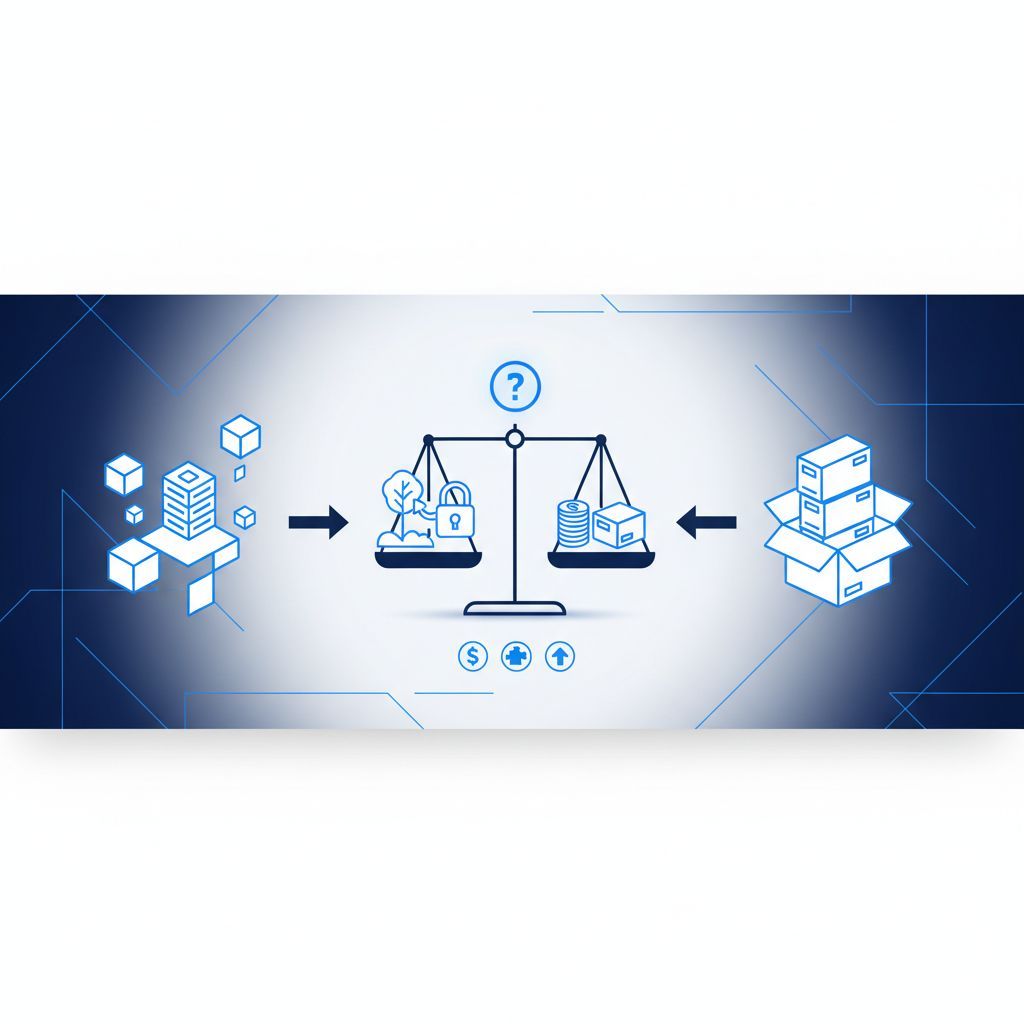
Your business has outgrown its current tools. Spreadsheets are breaking down, your team is manually copying data between systems, and the software you bought three years ago no longer fits how you operate. You have two options: build custom software from scratch or buy an existing solution off the shelf.
Neither answer is automatically right. The wrong choice costs you time, money, and momentum. This comparison breaks down both options so you can make a clear, confident decision for your business.
What Off-the-Shelf Software Actually Means
Off-the-shelf software is any pre-built platform designed to serve a broad range of businesses. Think QuickBooks, HubSpot, Salesforce, Shopify, or any industry-specific tool built for the average user in your vertical.
These platforms are fast to deploy, relatively affordable to start, and backed by large support teams. You pay a subscription, configure the settings, and you are up and running within days or weeks.
The tradeoff? These tools are built for the widest possible audience, not your specific business. You will often find yourself working around their limitations, paying for features you never use, or forcing your team to adapt their workflow to fit the software instead of the other way around.
What Custom Software Development Actually Means
Custom software development means building a tool specifically for your business, your processes, and your users. No compromises. No unnecessary features. No workarounds.
A development partner works with you to understand how your business operates, what your team needs, and what outcomes you are trying to achieve. From there, they design and build software that fits your exact requirements.
This takes longer than buying off the shelf. It costs more upfront. But the result is a system that works the way your business works, not the other way around.
Head-to-Head Comparison: The Four Factors That Matter
1. Cost
Off-the-shelf: Low barrier to entry. Most platforms start at a monthly subscription ranging from $10 to a few hundred dollars per user. But costs compound. Add-ons, integrations, premium tiers, and per-seat pricing can push annual spend into five or six figures for a mid-sized team. And you are paying indefinitely, even when the tool stops serving you well.
Custom software development: Higher upfront investment. Depending on complexity, a custom-built solution can range from $25,000 to well over $150,000. But you own it. There are no per-seat fees eating into your margins every month. Over three to five years, many businesses find that custom software costs less than accumulating SaaS subscriptions that never fully meet their needs.
The verdict: If budget is tight and your needs are generic, start with off-the-shelf. If your needs are specific and you are spending heavily on workarounds, custom software often wins on long-term economics.
2. Time to Deploy
Off-the-shelf: Speed is the biggest advantage. You can sign up today and have your team using the tool by the end of the week. For businesses that need a quick fix, this matters.
Custom software development: Development takes time. A straightforward project might take three to six months. Complex platforms can take a year or more. You need to factor in discovery, design, development, testing, and rollout. There is no shortcut here.
The verdict: If you need something now, off-the-shelf wins. If you are planning six to twelve months out and your current tools are holding you back, the development timeline is a manageable tradeoff.
3. Fit to Your Business
This is where the comparison gets decisive.
Off-the-shelf: These tools are built for a broad audience. If your business operates like most businesses in your industry, the fit will be good enough. But if you have unique processes, a specialized service model, or operational requirements that fall outside the norm, you will spend a lot of energy bending your workflow to match the software.
That is not a small problem. When your team has to work around their tools instead of with them, productivity drops, errors increase, and frustration builds.
Custom software development: Built entirely around how your business operates. If your process is unique, the software reflects that. If your team has specific reporting needs, approval workflows, or customer-facing requirements, those get built in from the start.
Businesses with specialized workflows, particularly in healthcare, logistics, legal, construction, and professional services, often find that no off-the-shelf product comes close to covering what they actually need.
The verdict: For standard operations, off-the-shelf is fine. For businesses with differentiated processes or complex operational requirements, custom software development is the only option that truly fits.
4. Scalability and Control
Off-the-shelf: You are at the mercy of the vendor’s roadmap. Features get added based on what the majority of their customers want, not what you need. Pricing can increase. Products get acquired. Platforms get discontinued. You have no control over the direction of the tool your business depends on.
Integrations help, but they introduce their own fragility. When one platform updates its API or changes its pricing, your entire stack can break.
Custom software development: You own the code. You control the roadmap. When your business grows or pivots, your software can adapt. You are not waiting for a vendor to prioritize your feature request. You are not migrating to a new platform every two years because the old one stopped scaling.
Custom software also integrates cleanly with your existing systems. A skilled development partner builds with your current infrastructure in mind, including your cloud environment, your data sources, and any compliance requirements your business must meet.
If your business is subject to data privacy or industry regulations, a custom-built solution gives you far more control over how data is stored, accessed, and protected. Pairing this with strong cybersecurity services ensures your custom platform is secure from day one, not retrofitted later.
The verdict: Off-the-shelf works until it does not. Custom software grows with you and stays under your control.
When Off-the-Shelf Is the Right Call
Off-the-shelf software makes sense when:
- Your needs align closely with what the platform was designed to do
- You are an early-stage business that needs to move fast and prove your model before investing heavily in infrastructure
- The problem you are solving is generic, like basic accounting, email marketing, or project tracking
- Budget is constrained and you cannot absorb a large upfront development cost
- You need something running within days, not months
For these situations, buy the tool, configure it well, and focus your energy on your core business. There is no shame in using proven platforms where they fit.
When Custom Software Development Is the Right Call
Custom software development makes sense when:
- Your workflows are unique and no existing tool handles them without significant compromise
- You are paying for multiple overlapping platforms and still doing manual work in between
- Your off-the-shelf tool is creating bottlenecks that limit growth
- You need deep integration across systems that do not play well together
- Data ownership, security, or compliance requirements demand more control than a vendor platform can offer
- You have a competitive process or method that should not live inside a platform your competitors also use
Many businesses reach this inflection point around the time they cross 20 to 50 employees, or when they start scaling a process that was manageable at smaller volume but breaks under pressure.
If you are not sure where you fall, an IT strategy consultation can help you map out your current systems, identify where the friction is, and determine whether custom development, process automation, or a different configuration of your existing tools is the right next move.
The Hybrid Approach: A Third Option Worth Considering
Not every situation is binary. Some businesses get the most value from a hybrid approach: using off-the-shelf platforms for standard functions like accounting, HR, or communication, and building custom software for the parts of the business that are truly differentiated.
For example, you might use a standard CRM for sales pipeline management but build a custom client portal that gives your customers a branded, tailored experience. Or you might use an existing project management tool internally but build a custom integration layer that connects it to your proprietary data.
Business process automation can also bridge gaps between platforms, reducing manual work without requiring a full custom build. Sometimes the right answer is not building an entirely new system but automating the handoffs between the systems you already have.
What to Ask Before You Decide
Before committing to either direction, get clear on these questions:
- What is the specific problem we are trying to solve, and how much is it costing us right now in time or errors?
- Have we fully explored and configured the tools we already have?
- How much will off-the-shelf actually cost us over three years, including all add-ons and integrations?
- Is our process unique enough that a custom build would give us a competitive advantage?
- Do we have the internal capacity to manage a development project, or do we need a partner who can run it for us?
The answers will make the right path much clearer.
Ready to Take the Next Step?
Miami Cyber’s development services team works with SMBs to evaluate their current software landscape and build solutions that fit how they actually operate. Whether you are ready to start a custom software development project or you want an honest assessment of whether your current tools can be made to work better, we can help you move forward with clarity and confidence.