
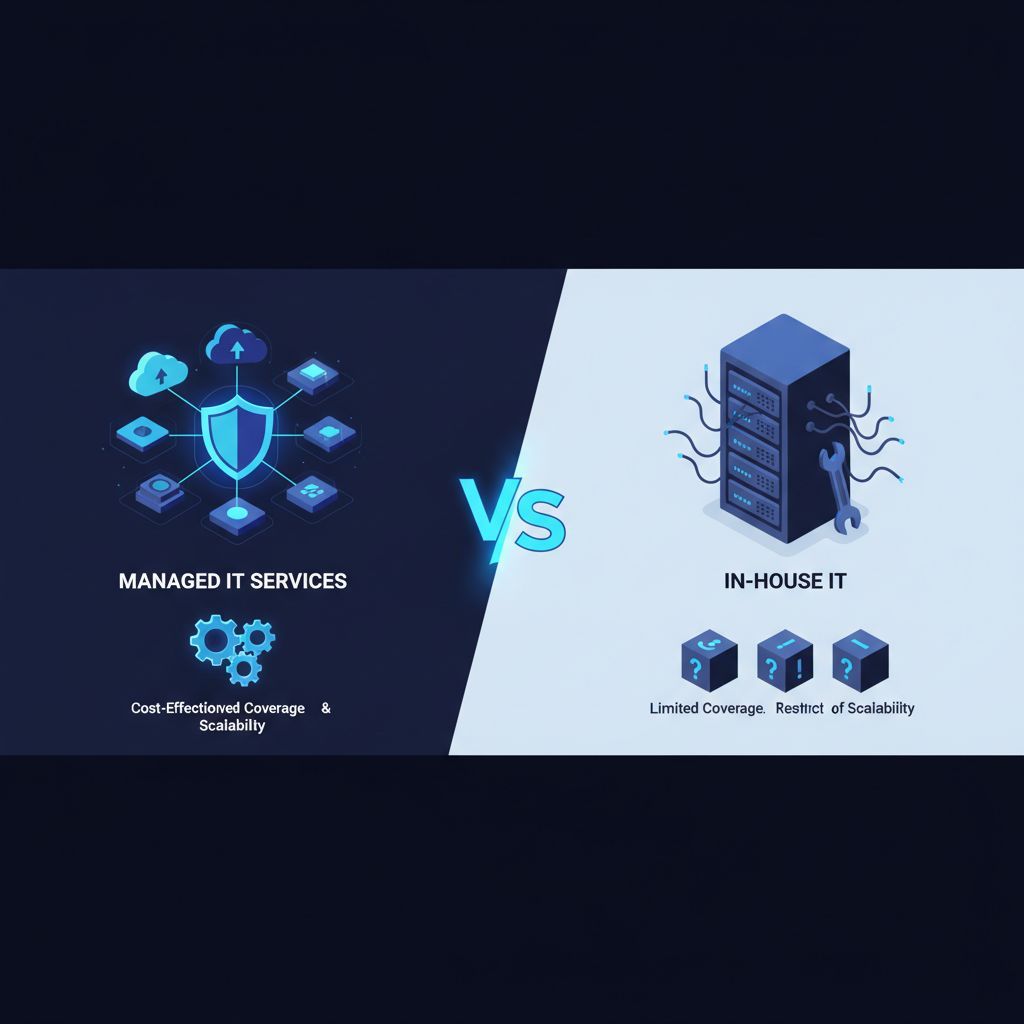
Every growing business hits the same crossroads: your technology is becoming too critical to ignore, and something has to give. You are either paying someone on staff to keep the lights on, or you are thinking about outsourcing it entirely. Both options come with real trade-offs, and choosing the wrong one can cost you far more than money.
This post breaks down managed IT services versus in-house IT across the factors that actually matter to a business owner: cost, coverage, scalability, and risk. No technical jargon. Just a clear comparison so you can make the right call.
What Each Model Actually Means
Before comparing them, it helps to know exactly what you are choosing between.
In-house IT means hiring one or more employees to manage your technology internally. They work for you full-time (or part-time), handle day-to-day support, and are on-site when needed.
Managed IT services means partnering with an external provider who takes responsibility for your technology environment. They monitor your systems, handle support, manage vendors, and proactively address problems, typically for a flat monthly fee.
Both models can work. The question is which one works for your business right now.
Cost Comparison: What You Actually Pay
This is where most business owners start, and for good reason.
In-House IT Costs
Hiring an IT generalist in the United States typically runs between $55,000 and $85,000 per year in base salary. Add benefits, payroll taxes, paid time off, and equipment, and you are realistically looking at $75,000 to $110,000 per year for a single mid-level hire. That number goes up significantly if you need someone with deeper expertise.
And here is the problem: one person cannot cover everything. They have a ceiling on their knowledge, and they are unavailable nights, weekends, and holidays unless you pay extra.
Managed IT Services Costs
A managed IT services provider typically charges on a per-user or per-device basis. For SMBs, monthly costs commonly range from $100 to $250 per user, depending on the level of service. For a 20-person company, that is roughly $2,000 to $5,000 per month, or $24,000 to $60,000 per year.
That cost buys you an entire team: help desk technicians, network engineers, security specialists, and often a virtual CIO who helps align your technology with your business goals. The breadth of coverage you get from a managed provider simply cannot be replicated by a single employee at the same price point.
Winner on cost for most SMBs: Managed IT services. Unless you have enough volume and complexity to justify a full internal team, the math rarely favors in-house.
Coverage and Expertise: Who Can Actually Handle Your Problems?
The In-House Reality
In-house IT staff are generalists by necessity. They handle password resets, laptop setups, printer issues, and basic network troubleshooting. That works fine until something serious happens, like a server failure, a cybersecurity incident, or a major software migration.
When those situations arise, your in-house person either figures it out slowly, brings in an expensive outside consultant, or both. You also hit knowledge gaps constantly. A single IT employee is unlikely to have deep expertise in cloud infrastructure, cybersecurity, compliance, and end-user support all at once. Those are four different career paths.
What Managed IT Services Bring
A quality managed services provider gives you access to a bench of specialists. When a security alert fires at 11pm, there is someone monitoring it. When you need to evaluate a new platform or migrate your data to the cloud, there is an engineer who has done it dozens of times. When your industry has compliance requirements, there is a specialist who knows the rules.
This model also pairs well with a dedicated IT strategy consulting relationship, where an experienced advisor helps you make technology decisions that actually support your business goals, not just keep the status quo running.
Winner on coverage: Managed IT services. Depth, breadth, and around-the-clock availability are nearly impossible to match with one or two internal hires.
Scalability: Can Your IT Keep Up With Your Growth?
Scaling In-House IT Is Painful
When your business grows, your IT needs grow with it. Adding five employees means more devices, more software licenses, more support tickets, and more complexity. With in-house IT, that growth often means hiring another person, which is a lengthy, expensive process. You are also exposed during transitions: when your IT person quits, gets sick, or takes vacation, coverage evaporates.
That single point of failure is one of the most underrated risks of the in-house model. Many business owners have learned this the hard way after an IT employee leaves with institutional knowledge that was never documented.
Managed IT Services Scale With You
With a managed provider, scaling is straightforward. You add users to your plan. The provider adjusts. There is no hiring cycle, no onboarding ramp-up, and no knowledge loss. Whether you go from 10 employees to 20 or open a second location, your IT coverage expands without disruption.
This also means you are never overpaying for capacity you do not need. Most managed IT agreements are structured to flex up or down as your headcount changes.
Winner on scalability: Managed IT services. The flexibility simply is not available in the in-house model without significant additional investment.
Security and Risk: Where the Stakes Are Highest
This category is non-negotiable for any business handling client data, financial records, or sensitive operations.
In-House IT and Security Gaps
Most in-house IT generalists are not cybersecurity specialists. They can set up antivirus software and enforce password policies, but they are not running threat detection, monitoring your network for anomalies, or responding to active incidents at the level modern threats require.
Cybercriminals know this. SMBs are increasingly targeted precisely because their security posture is often weaker than enterprise organizations. A single breach can cost tens of thousands of dollars in downtime, recovery, legal liability, and reputational damage.
Managed IT Services and Built-In Security
The best managed IT providers bake security into their service model. That means endpoint protection, patch management, multi-factor authentication enforcement, and proactive monitoring, all as part of the baseline service. Many also offer access to managed cybersecurity services that go deeper, including threat detection, vulnerability assessments, and incident response.
For businesses in regulated industries, this level of coverage also supports compliance requirements that an in-house generalist would struggle to maintain consistently.
Winner on security: Managed IT services. Purpose-built security coverage is simply out of reach for most in-house IT configurations at the SMB level.
When In-House IT Actually Makes Sense
Fair is fair. In-house IT is not always the wrong answer. Here are the scenarios where it genuinely makes sense:
- You have 100+ employees and enough volume to justify a full internal team with diverse specializations.
- Your business has highly specialized or proprietary systems that require dedicated, on-site expertise unavailable through a managed provider.
- You are in an industry with unique physical IT requirements that demand hands-on presence throughout the day, every day.
- You are building toward an enterprise IT department and need foundational internal staff before layering in managed services.
Even in these cases, many larger companies use a hybrid model: a small internal team for day-to-day presence, with a managed provider handling monitoring, security, and strategic oversight.
The Hybrid Model: Best of Both Worlds
For mid-sized businesses that have already hired one or two IT staff, the hybrid model is worth serious consideration. Your internal person handles physical tasks, institutional knowledge, and user relationships. Your managed provider handles monitoring, security, vendor management, and anything outside the internal team’s expertise.
This setup also gives your internal staff a resource to escalate to when problems exceed their skillset, which makes them more effective and reduces the risk of costly errors made under pressure.
If your business is at that inflection point, pairing internal staff with a managed IT partner can deliver better outcomes than either option alone.
Side-by-Side Summary
| Factor | In-House IT | Managed IT Services |
|---|---|---|
| Annual Cost (20 users) | $75K–$110K+ per hire | $24K–$60K |
| Coverage Hours | Business hours only | 24/7/365 |
| Expertise Depth | Generalist | Multi-specialist team |
| Scalability | Slow, costly | Flexible, immediate |
| Security | Limited | Built-in and proactive |
| Risk of Coverage Gap | High (single point of failure) | Low |
| Strategic IT Guidance | Rarely included | Often included |
Making the Decision for Your Business
The right model depends on your size, your growth trajectory, your risk tolerance, and what you need IT to actually do for your business.
If you are under 100 employees and IT is not your core competency, managed IT services will almost always deliver more value per dollar than building an in-house team. You get broader expertise, better security, and predictable costs, without the overhead and risk of depending on a single employee.
If you are growing fast and need technology to be a strategic advantage rather than just a cost center, a managed provider with access to business continuity planning and strategic IT guidance can help you scale without falling behind.
If you are already running an in-house team and feel gaps forming, a hybrid approach might be your answer. But be honest about what those gaps are costing you in lost productivity, security exposure, and reactive fire-fighting.
The best IT setup is the one that keeps your business running, your data protected, and your team able to focus on work that actually grows revenue.
Ready to Take the Next Step?
Miami Cyber specializes in managed IT services built for SMBs that are serious about growth, security, and operational stability. Whether you are evaluating your first managed IT partner or rethinking a setup that is no longer working, our team can walk you through a clear, honest comparison based on your specific situation. Reach out today and let’s figure out what the right model looks like for your business.